

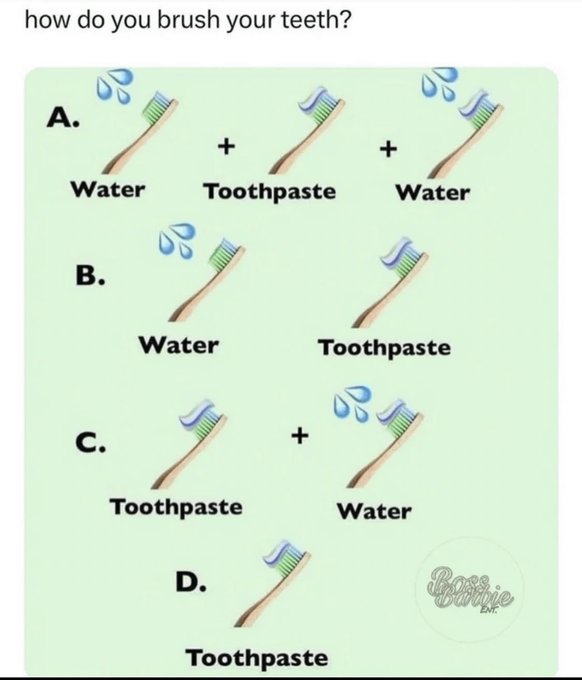
I saw this post on Twitter last night. It was a nice visual representation showing whether you wet your toothbrush or use toothpaste on a dry toothbrush while brushing your teeth. Honestly, I apply toothpaste directly to a dry toothbrush and brush my teeth that way. I think I learned this years ago, probably on a TV or radio program, although I can’t recall the exact source. They mentioned that it is not necessary to wet the toothbrush and that applying toothpaste on a dry toothbrush is just fine. Since that day, I have been using toothpaste directly on a dry toothbrush to brush my teeth.
It is generally recommended to wet your toothbrush bristles before applying toothpaste. Wetting the bristles helps to moisten them, making it easier for the toothpaste to spread and adhere to the bristles. Additionally, wetting the toothbrush can help create a bit of lather and improve the overall brushing experience. So, it’s best to start by wetting your toothbrush bristles with clean water before applying toothpaste.
Brushing your teeth is an important part of maintaining good oral hygiene. Here’s a step-by-step guide on how to brush your teeth using water and toothpaste:

- Start by wetting your toothbrush bristles with clean water. The water helps to moisten the bristles and make the toothpaste spread more easily.
- Squeeze a pea-sized amount of toothpaste onto the bristles of your toothbrush. It’s important not to use too much toothpaste as it can be wasteful and may lead to excessive foaming.
- Hold your toothbrush at a 45-degree angle to your gums. This angle helps to clean both the teeth and the gumline effectively.
- Using gentle, circular motions, brush the outer surfaces of your teeth. Start with the upper teeth and then move on to the lower teeth. Make sure to cover all areas, including the chewing surfaces and the back of your teeth.
- After brushing the outer surfaces, move to the inner surfaces of your teeth. Tilt your toothbrush vertically and use up-and-down strokes to clean the inner surfaces.
- Next, brush the chewing surfaces of your molars. These surfaces have grooves where food particles can get trapped, so it’s important to clean them thoroughly.
- Pay attention to your gumline while brushing. Gently brush along the gumline to remove any plaque or food particles.
- Don’t forget to brush your tongue as well. Brushing your tongue helps to remove bacteria and freshens your breath. You can do this by gently brushing your tongue from back to front.
- Continue brushing for at least two minutes. You can use a timer or divide your mouth into quadrants, spending about 30 seconds on each section.
- Rinse your mouth with water to remove the toothpaste and any loosened debris.
- Spit out the water and avoid rinsing your mouth with water immediately after brushing. This allows the fluoride in the toothpaste to remain on your teeth for longer, providing additional protection against tooth decay.
- Finally, clean your toothbrush by rinsing it thoroughly with water and allowing it to air dry. Store it upright in a clean, dry place.
Remember to brush your teeth at least twice a day, preferably after breakfast and before bed. It’s also important to replace your toothbrush every three to four months or sooner if the bristles become frayed. Additionally, visit your dentist regularly for check-ups and professional cleanings.
“This text contains an affiliate link” that the text or content being referred to includes a hyperlink that is affiliated with an affiliate program. Affiliate links are special URLs that include a unique identifier for an affiliate, who earns a commission or referral fee when someone clicks on the link and makes a purchase or performs a specific action on the linked website.